Does a Towbar Need to Be Declared or Checked at MOT?
13 August 2026 by SEO
Having a towbar fitted can make your vehicle far more practical. Whether you tow a caravan, transport equipment in a trailer or use a towbar-mounted cycle carrier, the right setup gives you greater flexibility without changing vehicles.
However, fitting a towbar also raises two common questions: does it need to be declared, and will it be checked during the vehicle’s MOT?
The straightforward answer is that you should tell your insurer about a newly fitted towbar, and the towbar will normally form part of your vehicle’s MOT inspection. That does not mean you need to arrange a separate MOT immediately after installation, but the towbar must be correctly fitted, securely attached and kept in a safe condition.
Understanding the rules can help you avoid MOT problems and unnecessary concerns before your next towing journey.
Separate cover may be required for accidental damage, theft, contents or recovery.
Do You Need a New MOT After Towbar Installation?
You do not normally need to arrange a fresh MOT simply because a towbar has been fitted.
Your existing MOT certificate remains valid until its expiry date, provided the vehicle continues to meet legal roadworthiness requirements. The towbar will then be inspected, where applicable, as part of the vehicle’s next scheduled MOT.
Nevertheless, a valid MOT certificate is not a guarantee that every component remains safe for the entire year. Drivers are responsible for ensuring their vehicles stay roadworthy between tests. If the towbar becomes loose, damaged or heavily corroded, it should be inspected rather than left until the next MOT.
Professional installation is therefore important. A towbar must be compatible with the specific make and model of the vehicle, attached at the correct mounting points and paired with suitable electrics.
For most passenger cars first used on or after 1 August 1998, the towbar must also be type approved. A type-approved towbar has been tested for use with the relevant vehicle and carries an approval label showing its approval number and compatible application.
What Does an MOT Tester Check?
During an MOT, the tester examines accessible parts of the towing equipment without dismantling the vehicle. The inspection focuses primarily on security, condition and safety.
The tester may assess whether the towbar is:
-
Securely attached
The mounting brackets, bolts and other accessible attachment points should be secure. Serious movement or an insecure component could result in an MOT failure.
-
Free from significant damage
Cracks, fractures, deformation and serious corrosion may affect the strength of the towbar. A damaged component must not be relied upon to handle towing forces safely.
-
Operating correctly
A detachable or retractable towbar should secure properly when placed in its towing position. Retractable systems are tested in the in-use position when they can be operated without tools.
-
Positioned safely
The towbar should not dangerously obstruct the registration plate, rear lamps or other essential vehicle components. The towball and associated equipment must also be suitable for their intended application.
The tester may also inspect visible electrical wiring and the trailer socket. The exact electrical checks can depend on the type of socket fitted, but loose cables, insecure wiring or components that present an obvious safety issue should be addressed before the test.
Can a Towbar Cause an MOT Failure?
A properly selected and professionally fitted towbar should not cause your vehicle to fail its MOT. Problems are more likely when the equipment has been poorly installed, damaged in a collision or neglected over time.
Potential causes of an MOT failure include an insecure mounting, a fractured or seriously corroded component, an unsafe locking mechanism or a towbar that creates a significant safety problem.
A detachable towball being removed before the test does not necessarily remove the towing equipment from the inspection. When the attachment brackets remain installed, the tester may still assess the accessible parts of the system.
Removing a detachable towball solely to conceal a known defect is not a suitable solution. If there is movement, corrosion or difficulty locking it into place, the equipment should be checked by a towbar specialist.
Should You Remove a Detachable Towbar Before the MOT?
You can normally leave a detachable towball removed when the vehicle is not being used for towing. Many motorists choose detachable systems because they preserve the vehicle’s appearance and help maintain access to parking sensors, cameras or the boot.
Before the MOT, check that the receiver is clean, protected and free from excessive corrosion. If the towball is fitted, make sure it locks securely and that any indicator shows the correct locked position.
Keep the towball, keys and protective cap in good condition. Dirt, road salt and moisture can gradually affect the locking mechanism, particularly if it is rarely used.
Towbar Checks to Complete Before Your MOT
A simple inspection can help identify obvious problems before the vehicle reaches the test centre.
Look underneath the rear of the vehicle and check for excessive rust, damaged brackets, missing fixings or visible movement. Inspect the electrical socket and confirm that its cover closes properly. Wiring should be supported rather than hanging beneath the bumper.
If you tow regularly, connect your trailer or caravan and test the road lights, indicators, brake lights and fog light. You should also inspect the breakaway cable, safety connection and coupling equipment before every journey.
Do not attempt to tighten structural fixings or modify the towbar unless you have the correct specifications and experience. Incorrect work could weaken the installation or damage the vehicle.
Professional Towbar Fitting Provides Greater Peace of Mind
Choosing a towbar is not simply a matter of finding a component that appears to fit. Vehicle design, towing capacity, bumper configuration, parking technology and electrical systems must all be considered.
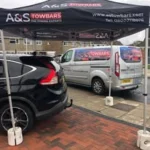
A&S Towbars supplies and installs towing equipment for a wide range of vehicles. Its services include towbar fitting, mobile installation, trailers, cycle carriers and roof racks, helping customers choose equipment that suits both their vehicle and intended use.
Professional fitting also reduces the risk of loose mountings, incompatible components and electrical faults. Once the installation is complete, remember to notify your insurer and retain any paperwork supplied with the towbar.
Arrange Your Towbar Installation with A&S Towbars
A towbar should be declared to your insurer and will normally be considered during your vehicle’s MOT inspection. Although fitting one does not usually mean arranging an immediate MOT, the equipment must remain secure, correctly installed and roadworthy.
For expert advice, towbar supply or professional fitting, contact A&S Towbars. The team can help you select a suitable system and install it correctly for dependable everyday use.
Call 0800 211 8076 or email sales@astowbars.co.uk to request a quote or discuss your towing requirements.